

the first part of this article relating to long lute is found Who
the second part relating to colascione you can find it Who
the third part of the article relating to short lute and the Arabian lute is found Who.
Our evolutionary path continues with the addition of low strings tuned at pitch distance, the Lute is increasingly preparing to also play an accompaniment role, both the voice and other solo instruments, until the birth of the archlute.

The archlute was tuned like the early Renaissance lute but saw the enlargement of the body and the addition of drones (individuals), tuned at pitch distance, thesis on a route (extension of the handle) in some models even one meter long, until the total number of is reached 14 cori. The archlute was thus used to make the basso continuo, performance practice in vogue at the end of the 16th century which would lay the foundations for the arrival of the work.
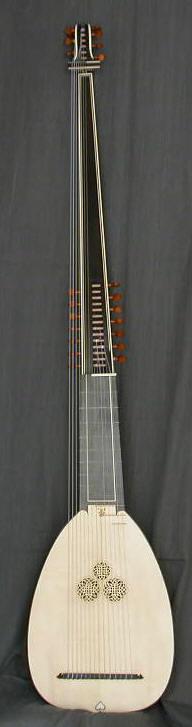
Another variant of lutes spread to northern Europe, France and Germany in the 17th century., the so-called Lute atorbati or Lute in re –, they featured the addition of a small anklet that supported up to four choirs, the most serious, and had a total of 13 cori. For this instrument authors such as Weiss and J. S. Bach. It was mostly used in the performance of solo pieces or in duos and trios with other instruments, and he rarely performed the continuous bass. Another important Italian invention was the chitarrone, also called theorbo. It was born from the idea of strengthening the sound of the lute by starting from a larger body and tuning the lower pairs higher: in this way a wider sound was produced through long and thin strings. The two upper pairs could not be raised but were kept an octave below the corresponding lute strings. The different tuning brought advantages to the sound of the chords, which were thus more compact without the need to change the fingerings of the left hand. And when the big guitar was used as accompaniment, it couldn't cover the sound of the voice. In fact, its use intensified with the advent of accompanied monody and musical opera, and many Italian vocal music publications from the first half of the 17th century indicate it as the best instrument for playing the bass. The big guitar also received a second anklet, and several instruments that have come down to us have strings up to 99 centimeters and tuning forks of more 180 centimeters, thus testifying to its origin in the bass lute. Normally it had, like the archlute, fourteen pairs of strings, but virtuosos such as Giovanni Girolamo Kapsperger published music for chitarrone with nineteen choirs. The range of these instruments was no greater than that of guitars with fewer strings, but they had a greater number of chromatic notes in the bass.




 Ecological Web Hosting
Recent Comments