


the first part of the article relating to long lute you can find it WHO
The second part where we talk about colascione you find it WHO
We continue our exposition by describing the Corto lute: the Persians still hand down to us the first iconographies of L. short and therefore of an instrument with a shorter handle than the body. Subsequently the case from circular becomes pear-shaped, it became heavier until it merged entirely with the handle. We therefore have examples of short lutes in the Far East: in China the suang-k'in, in Japan the genkwan or sigen. India also has venerable testimonies in reliefs from Kashmir in the style that was called Gandhara, an area that underwent strong Hellenistic influences. L'Iran, ad es., builds short lutes carved from a single piece of wood and, still in the Middle East, the anklet begins to appear bent backwards.
 The Arabic Lute or "Ud" which as previously mentioned means wood would denounce the practice of indicating the instrument with the material with which it is made, but Sachs opposes this consideration, seeing in the term an allusion to the flexible stick , referring to the concept according to which the Lute was derived from the musical bow. A similar correlation can be accepted with the Mesopotamian pan-tur, where the stick perhaps suggests an allusion to the handle of the instrument. However, the term Ud arrived in Europe via Spain, creating our word Lute. The oldest iconographic testimony of the European lute is in an ivory made in Cordoba, around 968 and today preserved in the Louvre. Another source is provided by a German psalter from the 10th century. which depicts a "short lute" reproduced in the ten copies of the Bible preserved at the State Library of Stuttgart.

These images are very imperfect and the number of pegs, except in one case, it never corresponds to the number of strings. However, it must be remembered that Spain, with miniatures from the 10th and 11th centuries. has the richest documentation, confirming itself as the country of origin of the European version of the Lute. From Spain, the Lute, following the Moors, he entered Sicily and little by little became more and more influential in musical life. During the 14th century. the Lute was plucked with a quill plectrum, the number of choirs (double strings) it was four, and the handle, longer than the case, it had no buttons. During the 15th century. the neck was equipped with frets, four initially, gradually increased to eight, a fifth pair of strings was added to the soprano. The choirs are therefore 5, double the first ones in unison 4 and the fifth is simple (sing). The distance of a fourth between the first and second strings, and a major third between the second and third, to then resume the fourth quarter interval, they are characteristics that implant the classic chordal armature of the instrument. Around the 1500 the further addition of a sixth pair on the bass brought back the symmetry of the tuning that had been typical of the medieval lute, with the third interval placed in the center of the instrument, therefore the Renaissance model, with six choirs, the first chorus is a simple song, the second, third and fourth doubled in unison, the fifth and sixth doubled in the octave. The tuning 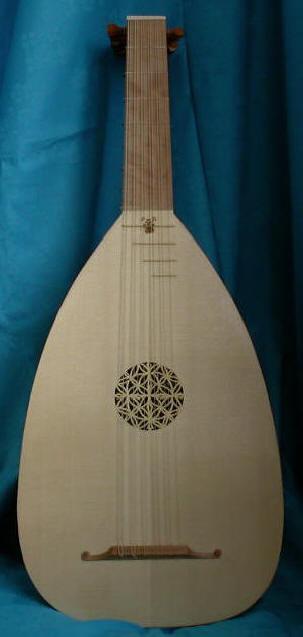 in the octave of the choirs was made possible, for low sounds, from the use of gut strings, the excessive diameter of the strings precluded the production of high harmonics, which is why it was doubled with another string, covered in silver with a silk core, tuned to the octave. The aesthetic profile of the instrument acquired its definitive physiognomy around 1500; since then it had an elegant almond shape and a shallower case. The thin slats , from nine to thirty-three, that made up the case were sometimes made of exotic wood: ebony, Brazilian rosewood, sandal, cypress, or ivory and even whalebone, and often separated from each other by delicate fillets.
This is where the use of bare fingers began to establish itself, and both modes of execution are mentioned by Tinctoris (ca. 1480).

The replacement of bare fingers with the plectrum marked the transition from monodic to polyphonic practice, at the same time, the affirmation of the Lute as a solo instrument; Tinctoris himself reports, with admiration, of lute performance a 2, 3 or also 4 party. The Lute had a real family of capable of forming a real consort with lutes of four different sizes: the soprano, contralto, tenor and bass. These instruments differed from each other in the size, tuning and length of the strings. Over the time, and with the increase in musical needs, always dictated by a greater production of literature for solo lute, the instrument in the late Renaissance period reached the number of 11 cori.




 Ecological Web Hosting
Recent Comments