
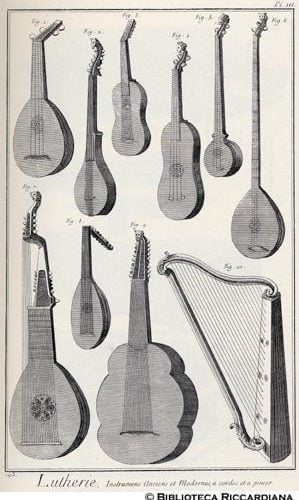
The lute and its organological evolution.
Composite chordophone with shell neck handle. It has a rounded pyriform case, short handle, 7 or more keys, anklet turned backwards at a right angle.
The term Lute derives from the Arabic “Ud” (Wood) organologically it is a word that designates a specific instrument, but also adopted to generically understand an ancient family of instruments. In the first case, clearly, reference is made to the instrument derived from the Arabic “Ud”., imported into Europe by the Moors during their occupation of Spain (711-1492). The Crusades and trade relations with the Middle East favored the penetration of the instrument into other parts of Europe during the Middle Ages. In the second case, the word Lute was adopted to generically indicate the instruments prior to the importation of the Arabic instrument, used in ancient times and structured with an almost always oval case and long or short handle. The name probably derives from the material with which it was built, in opposition to other materials such as leather for the soundboard or tortoise shell for the rounded body. The Ud root was maintained over the centuries with great tenacity, passing into European languages and merging with his article (all-out). In Italian Lute, in French Luth, in German Laute, in English Lute, in Dutch Luit, in Swedish Luta, etc..
Historically it is divided into two categories, Long Lute and Short Lute.
The long lute is the oldest and constitutes a family of instruments with a longer neck than the body; the history of the instrument extends from Mesopotamia (2000 a.C.) to the advent of the colascione, an instrument used in the Neapolitan popular tradition. Mesopotamia called the Long Lute pan-tur (literally little bow). Primitive manufacturers made it from vegetable shells and equipped it with a leather soundboard. For this reason the pan-tur case is small, the tool has a long handle, two strings knotted at the end of the handle without pegs. The Assyrians attribute the invention to Pollux, the Greeks to the Egyptians. The first statement is taken from the legend, the second linked to the fact that the Greeks often identified the origin of things in Egypt. The Persians did not accept the etymology and preferred to rely on a system well known to these peoples, that is, they indicated it with the number of strings: dutar (two-string type); setdr (three strings); cart (four strings); panctdr (five strings); the Arabs adopted the assonant term Tanbur. Egyptian iconography shows the Lute preferably in the hands of women. It maintains the oval body with leather soundboard and differs from the previous ones for the different way of attaching the neck to the body.
In the types already mentioned this conjunction was achieved in an elementary way by passing the stick longitudinally from side to side, thus obtaining an indispensable solidity for handling the instrument. The Egyptians rejected this solution which produced the handle protruding from the lower part of the case which was certainly not pleasant to look at. They managed to contain it in the cavity of the box, fixing it on an internal support or, embedding it in the skin, which constituted the soundboard, Over and under. There remained the problem of grasping the strings in the lower part of the handle which in this way would have been unreachable. The Arabs derived a metallic sound from the aforementioned tanbúr, practically indefinite, which concluded the verses of the song. In addition to the metal strings and the plectrum, the most important observation we can make with respect to the tanbúr concerns the presence of the T-shaped pegs inserted at the front and sides due to the influences of Arab practices, shutters and shutters. Il tanbúr a 3 rope (and then setdr) it is the most direct antecedent of our colascione.





 Ecological Web Hosting
Recent Comments